

- What People Think About Modern Education
- Why Modern Education Creates So Much Debate
- Education Has Become More Accessible
- Education Quality Varies Widely
- Technology Has Changed The Classroom
- Concerns About Too Much Screen Time
- Online Learning Offers Flexibility
- The Digital Divide Remains A Problem
- Teachers Remain Essential
- Teachers Need Better Support
- Standardised Testing Divides Opinion
- Test Scores Do Not Measure Everything
- Academic Pressure Worries Many Families
- Homework Is Often Debated
- Practical Skills Deserve More Attention
- Financial Education Is Increasingly Important
- Critical Thinking Matters More Than Memorisation
- Media Literacy Is Essential
- Creativity Should Not Be Treated As Optional
- Physical Education Supports More Than Fitness
- Student Wellbeing Has Become A Major Concern
- Bullying Can Damage Learning
- Student Voice Can Improve Schools
- Parent Involvement Can Help
- Schools And Families Need Clear Communication
- Class Size Affects Teaching
- Personalised Learning Sounds Promising
- Students Learn In Different Ways
- Inclusion Has Improved But Challenges Remain
- Vocational Education Deserves Respect
- Career Guidance Needs To Be Practical
- Education Should Prepare Students For Change
- Artificial Intelligence Creates New Questions
- Education Should Reflect A Changing World
- Cultural Knowledge Still Matters
- Education Reform Is Often Slow
- No Education System Is Perfect
- Questions Worth Asking About Education
- Common Misunderstandings About Modern Education
- How People Can Discuss Education Constructively
- Possible Poll Questions About Modern Education
- Conclusion
- FAQ
- What Are Common Opinions About Modern Education?
- Has Modern Education Improved?
- Is Technology Good For Education?
- Are Standardised Tests Useful?
- Should Schools Teach More Practical Skills?
- Is Homework Necessary?
- Why Is Teacher Support Important?
- Should Students Be Allowed To Use Artificial Intelligence?
- Is University The Best Option For Every Student?
- How Can Education Polls Be Made Fair?
What People Think About Modern Education
Education affects almost every part of society. It influences employment, health, communication, confidence, social mobility, and the way people understand the world. Because education matters so much, people often have strong and very different ideas about how schools should work.
Common opinions about modern education include support for technology, concern about academic pressure, questions about testing, and demands for more practical learning. Some people believe schools have improved by becoming more inclusive and flexible. Others feel that education systems are changing too slowly or focusing on the wrong priorities.
Parents, students, teachers, employers, and policymakers may all judge education differently. A parent may focus on safety and teaching quality, while an employer may care more about communication, problem-solving, and job readiness. Students may place greater importance on fairness, mental wellbeing, useful subjects, and respectful treatment.
This guide explores some of the most common opinions about modern education. It does not assume that one approach is suitable for every learner or country. Instead, it presents different viewpoints about classrooms, teachers, technology, testing, practical skills, equality, student wellbeing, and the future of learning.
👉 “Readers considering digital learning options may also explore helpful points to consider before choosing an online course.”
Why Modern Education Creates So Much Debate
Education systems are expected to achieve many goals at the same time.
Schools may be asked to:
- Teach reading, writing, maths, and science
- Prepare students for employment
- Develop creativity
- Support social skills
- Teach responsible citizenship
- Protect student wellbeing
- Reduce inequality
- Use technology
- Respect cultural differences
- Support students with different needs
- Prepare young people for further study
- Teach practical life skills
These goals can sometimes compete with one another. More time spent preparing for examinations may mean less time for art, discussion, sport, or project work.
Different opinions about modern education often come from disagreements about which goals should receive the most attention.
Some people want schools to focus on strong academic foundations. Others want more creativity, emotional development, technical training, or preparation for everyday adult responsibilities.
Education Has Become More Accessible
One positive view is that education is available to more people than in previous generations. In many places, more children attend school, complete secondary education, and have opportunities to continue into vocational training or university.
Supporters of modern systems may point to:
- Wider school access
- More support for girls
- Greater recognition of disability
- Adult-learning opportunities
- Online courses
- Flexible study programmes
- Distance education
- More educational resources
- Increased awareness of learning differences
These positive opinions about modern education recognise that access remains unequal but also acknowledge the progress made in many communities.
However, attending school does not always guarantee high-quality learning. Class size, teacher availability, family income, location, disability support, and access to technology can still affect educational opportunity.
Education Quality Varies Widely
Not every student receives the same quality of education. Schools may differ in funding, facilities, class size, teacher experience, technology, safety, and available subjects.
A child’s educational experience may depend on:
- Where the family lives
- Household income
- School funding
- Language
- Disability
- Transport
- Internet access
- Teacher availability
- Local policies
- Family support
Many critical opinions about modern education focus on these differences. People may believe that the system promises equal opportunity while allowing major gaps between schools and communities.
Improving access is important, but quality also matters. A school needs trained teachers, suitable materials, safe facilities, and enough time to support individual students.
Technology Has Changed The Classroom
Technology is one of the most visible changes in education. Students may use laptops, tablets, online platforms, digital textbooks, videos, interactive tools, and learning applications.
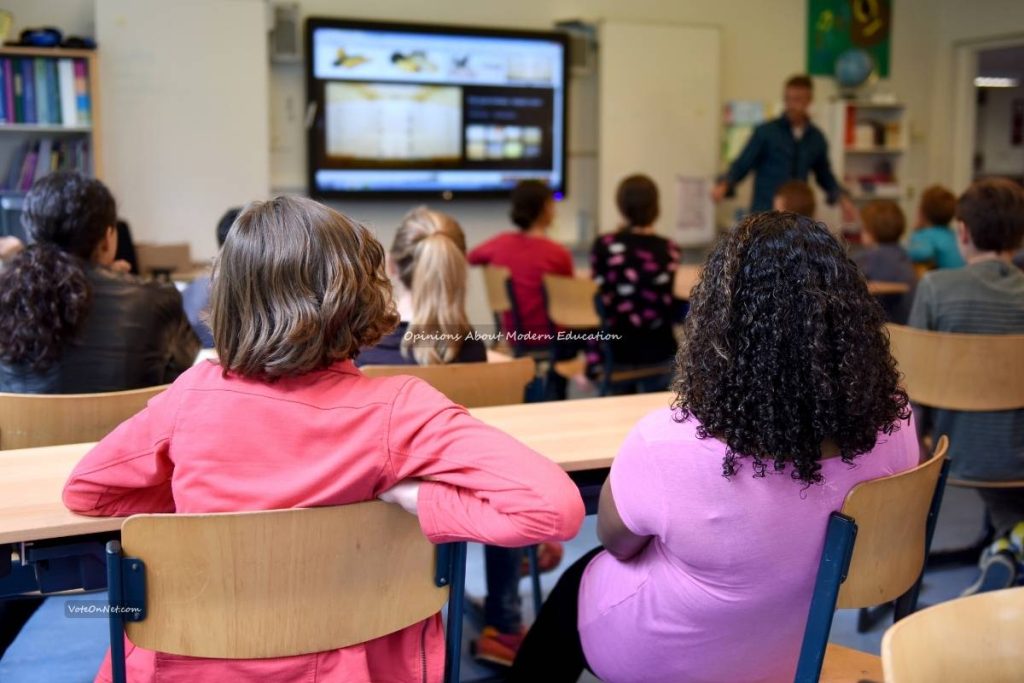
Supporters argue that classroom technology can:
- Provide access to information
- Support visual learning
- Make lessons interactive
- Help students practise independently
- Allow learning from home
- Connect schools with global resources
- Support students with some disabilities
- Improve communication
- Teach digital skills
Positive opinions about modern education often describe technology as essential preparation for modern work and communication.
However, devices alone do not create good learning. Schools also need suitable teaching methods, reliable internet, technical support, digital-safety rules, and clear educational goals.
Concerns About Too Much Screen Time
Not everyone supports increased technology use. Some parents and teachers worry that students already spend too much time using screens outside school.
Concerns may include:
- Reduced attention
- Less handwriting
- Fewer face-to-face conversations
- Online distraction
- Exposure to unsuitable content
- Privacy risks
- Cyberbullying
- Dependence on devices
- Reduced physical activity
- Difficulty checking information
These concerns shape cautious opinions about modern education. Technology may be helpful when it supports a clear learning purpose, but less useful when it simply replaces paper without improving the lesson.
A balanced approach may combine books, writing, discussion, practical tasks, outdoor learning, and carefully selected digital resources.
Online Learning Offers Flexibility
Online learning expanded rapidly and showed that education can continue outside a traditional classroom. It may help students who live far from schools, need flexible schedules, or want access to specialist subjects.
Possible advantages include:
- Learning from different locations
- Flexible scheduling
- Recorded lessons
- Wider course choices
- Reduced travel
- Self-paced study
- Access for some homebound learners
- Opportunities for adult education
Some favourable opinions about modern education see online learning as an important part of a more flexible future.
Yet online learning can also be difficult. Students may struggle with motivation, isolation, technical problems, or limited support. Younger children often need an adult nearby, which can create pressure for families.
The Digital Divide Remains A Problem
Online education assumes that students have reliable internet, a suitable device, electricity, and a quiet place to study. Many learners do not have all these resources.
A family may share one phone among several children. Internet costs may be high, or connections may be unreliable. Some homes do not have a desk or quiet room.
These inequalities influence negative opinions about modern education, especially when schools require digital participation without providing equal access.
Technology can reduce barriers for some students while creating new barriers for others. Fair digital education requires equipment, connectivity, training, and accessible alternatives.
Teachers Remain Essential
Even with online tools, artificial intelligence, and digital lessons, teachers remain central to education.
A good teacher can:
- Explain difficult ideas
- Notice confusion
- Adapt a lesson
- Encourage a nervous student
- Manage group discussion
- Give meaningful feedback
- Create a safe environment
- Connect learning to real life
- Recognise when additional support is needed
Many opinions about modern education emphasise that technology should support teachers rather than replace them.
Education is not only the delivery of information. Students also need guidance, motivation, feedback, trust, and human interaction.
Teachers Need Better Support
People often expect teachers to solve academic, social, behavioural, and emotional problems while managing large classes and administrative work.
Common teacher concerns include:
- Heavy workloads
- Large classes
- Limited preparation time
- Low pay
- Staff shortages
- Excessive paperwork
- Behavioural challenges
- Pressure from testing
- Limited classroom resources
- Lack of professional development
Reform-focused opinions about modern education frequently argue that improving schools requires better working conditions for teachers.
A system cannot provide consistent quality when experienced teachers leave because of exhaustion, low support, or unrealistic expectations.
Standardised Testing Divides Opinion
Standardised tests aim to measure student performance using the same questions or criteria. Supporters say they provide comparable data and help identify areas where schools need improvement.
Possible advantages include:
- Consistent measurement
- Progress tracking
- Identification of learning gaps
- School comparison
- Accountability
- Information for policymakers
Some opinions about modern education support testing as long as results are used carefully and do not become the only measure of success.
Critics argue that tests may narrow the curriculum, increase stress, and encourage schools to teach only what will appear in the examination.
Test Scores Do Not Measure Everything
Students may have strengths that are difficult to measure through written examinations.
These may include:
- Creativity
- Teamwork
- Leadership
- Curiosity
- Practical ability
- Communication
- Persistence
- Emotional awareness
- Artistic skill
- Technical ability
Critical opinions about modern education often argue that test scores provide only one part of the picture.
A student may understand a subject but perform poorly under time pressure. Another may memorise information successfully without understanding how to apply it.
Balanced assessment can include projects, presentations, practical tasks, portfolios, classroom participation, and examinations.
Academic Pressure Worries Many Families
Students may face pressure from schools, parents, entrance examinations, competition, and expectations about future careers.
Academic pressure can involve:
- Long school days
- Large amounts of homework
- Private tutoring
- Frequent testing
- Competition for grades
- Fear of failure
- University-entry pressure
- Limited free time
Many concerned opinions about modern education focus on whether students are learning effectively or simply working longer hours.
High expectations can encourage effort, but excessive pressure may reduce sleep, wellbeing, curiosity, and enjoyment of learning.
Education should challenge students without making them believe that one grade determines their entire future.
Homework Is Often Debated
Some people believe homework reinforces learning, builds responsibility, and helps parents understand what children are studying.
Others argue that too much homework:
- Reduces family time
- Creates conflict at home
- Limits physical activity
- Affects sleep
- Increases inequality
- Encourages parental overinvolvement
- Repeats tasks already completed at school
Different opinions about modern education may depend on the age of the student and the quality of the homework.
Short, meaningful practice may be more useful than repetitive assignments that take several hours. Homework should have a clear purpose and should be possible for students to complete without excessive adult help.
Practical Skills Deserve More Attention
Many people believe schools should teach more skills for adult life.
Suggested subjects include:
- Personal budgeting
- Cooking
- First aid
- Digital safety
- Basic repairs
- Employment applications
- Communication
- Taxes
- Consumer rights
- Time management
- Household organisation
- Media literacy
Practical opinions about modern education often argue that students should leave school knowing how to manage everyday responsibilities.
Supporters of traditional academic subjects may respond that schools cannot teach everything and that families and communities also have roles.
A balanced curriculum can include strong academic knowledge while connecting lessons to real situations.
Financial Education Is Increasingly Important
Young people may leave school without understanding loans, interest, credit, insurance, saving, or household budgets.
Financial education can introduce:
- Income and expenses
- Saving
- Interest
- Debt
- Credit
- Banking
- Fraud prevention
- Digital payments
- Basic taxes
- Long-term planning
Many opinions about modern education support financial literacy because money decisions affect daily life and future stability.
Financial lessons should remain practical and suitable for the student’s age. They should also avoid advertising particular companies or products.
Critical Thinking Matters More Than Memorisation
Information is now widely available online. This means students need to know how to evaluate it rather than simply find it.
Critical thinking may involve:
- Comparing sources
- Identifying evidence
- Recognising bias
- Asking questions
- Checking dates
- Distinguishing fact from opinion
- Detecting manipulation
- Understanding uncertainty
- Explaining reasoning
Forward-looking opinions about modern education often call for less memorisation and more analysis.
Basic knowledge remains necessary because students cannot evaluate a subject they know nothing about. The goal is not to remove knowledge but to teach students how to use it.
Media Literacy Is Essential
Students encounter news, advertising, influencers, edited videos, artificial intelligence, and false information every day.
Media literacy can help them ask:
- Who created this?
- Why was it published?
- What evidence is provided?
- Is it advertising?
- Has the image been edited?
- Is the source trustworthy?
- Are other views available?
- Is the information current?
Many modern opinions about modern education consider media literacy as important as traditional reading skills.
Students should learn to participate online safely, protect personal information, recognise scams, and avoid spreading unverified claims.
Creativity Should Not Be Treated As Optional
Art, music, drama, writing, design, and creative projects are sometimes reduced when schools focus heavily on tested subjects.
Supporters of creative education argue that it develops:
- Imagination
- Communication
- Confidence
- Observation
- Problem-solving
- Emotional expression
- Collaboration
- Cultural understanding
These opinions about modern education reject the idea that creative subjects are only hobbies.
Creative industries also provide employment, and creative thinking is useful in science, technology, business, and everyday problem-solving.
Physical Education Supports More Than Fitness
Physical education can help students develop movement skills, teamwork, confidence, and healthy habits.
A good programme may include:
- Games
- Swimming
- Dance
- Individual activities
- Team sports
- Fitness
- Coordination
- Outdoor learning
- Safe exercise knowledge
Some opinions about modern education criticise physical education when it focuses only on competition or naturally athletic students.
Schools can offer varied activities so that more students find a form of movement they enjoy. Physical education should encourage participation rather than embarrassment.
Student Wellbeing Has Become A Major Concern
Schools increasingly recognise that students cannot learn effectively when they feel unsafe, exhausted, isolated, or overwhelmed.
Wellbeing support may include:
- Safe classrooms
- Anti-bullying policies
- Counselling
- Rest and movement
- Reasonable workloads
- Supportive teacher relationships
- Clear behaviour rules
- Help during family difficulties
- Referral to professional services
Wellbeing-focused opinions about modern education argue that academic achievement should not come at the cost of physical or emotional health.
Schools are not able to solve every personal problem, but they can notice difficulties and connect families with appropriate support.
Bullying Can Damage Learning
Bullying may occur in classrooms, playgrounds, transport, sports, or online.
It can involve:
- Physical aggression
- Threats
- Social exclusion
- Rumours
- Insults
- Discrimination
- Online harassment
- Sharing private images
People’s opinions about modern education are often strongly affected by how schools respond to bullying.
A good response should protect the targeted student, investigate fairly, involve suitable adults, and address harmful behaviour. Simply telling children to ignore bullying may not be enough.
Student Voice Can Improve Schools
Students experience school policies directly, yet their views are not always included in decisions.
Student voice can involve:
- Surveys
- Councils
- Feedback sessions
- Class discussions
- Suggestion systems
- Participation in school projects
- Input on activities
Democratic opinions about modern education support giving students suitable opportunities to express concerns and ideas.
Student participation does not mean students control every decision. Adults remain responsible for safety, curriculum, and legal duties. However, listening can reveal problems that staff may not see.
Parent Involvement Can Help
Parents can support education by reading with children, discussing schoolwork, attending meetings, and communicating with teachers.
Useful involvement may include:
- Creating regular routines
- Encouraging attendance
- Providing a study space where possible
- Asking about learning
- Sharing relevant information
- Supporting reasonable school rules
- Contacting teachers when problems arise
Many opinions about modern education support parent involvement but warn against excessive control.
Parents completing projects, demanding perfect grades, or comparing children can increase pressure. The aim should be to support the student’s independence.
Schools And Families Need Clear Communication
Misunderstandings often develop when schools and families communicate only after a problem becomes serious.
Good communication may include:
- Clear expectations
- Regular updates
- Accessible language
- Respectful meetings
- Early discussion of concerns
- Information about available support
- Opportunities for questions
Cooperative opinions about modern education recognise that teachers and parents usually share the same broad goal: helping the student learn and develop.
Both sides should avoid blame and focus on practical solutions.
Class Size Affects Teaching
Large classes can make it harder for teachers to give individual feedback, notice confusion, manage behaviour, and support students with different needs.
Smaller classes may allow:
- More discussion
- Quicker feedback
- Individual attention
- Easier classroom management
- Stronger relationships
- Adapted instruction
Many opinions about modern education support smaller class sizes, especially for young children or students needing additional help.
However, reducing class size requires more teachers, classrooms, and funding. Policymakers must compare this investment with other possible improvements.
Personalised Learning Sounds Promising
Personalised learning aims to adapt content, pace, or support to individual students.
It may involve:
- Different reading levels
- Flexible groups
- Individual goals
- Choice of project topics
- Additional practice
- Advanced challenges
- Digital learning tools
- Specialist support
Supportive opinions about modern education see personalisation as a way to reduce boredom and frustration.
Critics worry that excessive individualisation may reduce shared classroom experiences or depend too heavily on technology. Teachers also need enough time and resources to plan varied work.
Students Learn In Different Ways
Students differ in background knowledge, language, interests, confidence, pace, and support needs.
Good teaching may use:
- Explanation
- Discussion
- Visual examples
- Practical activities
- Reading
- Writing
- Demonstration
- Repetition
- Group work
- Independent practice
Balanced opinions about modern education recognise diversity without placing every student into a fixed learning category.
Students may benefit from different methods depending on the subject and task. A child is not necessarily only a visual, auditory, or practical learner.
Inclusion Has Improved But Challenges Remain
Inclusive education aims to ensure that students with disabilities and additional needs can participate meaningfully.
Support may include:
- Accessible buildings
- Adapted materials
- Assistive technology
- Specialist staff
- Individual plans
- Extra time
- Communication support
- Flexible assessment
Positive opinions about modern education recognise greater awareness of disability and learning differences.
However, inclusion without enough staff, training, or resources may leave teachers overwhelmed and students unsupported. Real inclusion requires more than placing everyone in the same room.
Vocational Education Deserves Respect
University is not the only path to a successful future. Vocational education can prepare students for skilled work in construction, technology, healthcare, hospitality, transport, manufacturing, and other sectors.
Strong vocational programmes may include:
- Practical training
- Industry partnerships
- Apprenticeships
- Workplace experience
- Technical qualifications
- Safety training
- Employment guidance
Employment-focused opinions about modern education often argue that vocational routes should have equal respect with academic routes.
Students should not be pushed into one pathway because of stereotypes, family income, or weak career guidance. They need honest information about opportunities, costs, and requirements.
Career Guidance Needs To Be Practical
Students may choose subjects or courses without understanding future jobs, training requirements, salaries, or working conditions.
Useful career guidance may include:
- Skills assessment
- Workplace visits
- Talks from professionals
- Internship opportunities
- Training information
- University options
- Vocational routes
- Application support
- Labour-market information
Many opinions about modern education call for career education that begins before students make major subject choices.
Guidance should expand possibilities rather than pressure students into a narrow definition of success.
Education Should Prepare Students For Change
Young people may work in jobs that do not yet exist or change careers several times.
Schools cannot predict every future skill, but they can support adaptability through:
- Communication
- Digital literacy
- Collaboration
- Critical thinking
- Creativity
- Self-directed learning
- Problem-solving
- Ethical reasoning
- Resilience
- Technical foundations
Future-focused opinions about modern education often emphasise learning how to learn.
Students need confidence to update their knowledge, ask for help, and adapt when technology or employment changes.
Artificial Intelligence Creates New Questions
Artificial intelligence tools can explain concepts, generate text, translate languages, support research, and offer personalised practice.
Possible benefits include:
- Quick explanations
- Language support
- Accessible study help
- Practice questions
- Feedback
- Administrative support
- Adapted materials
However, AI also raises concerns about:
- Incorrect information
- Cheating
- Privacy
- Bias
- Reduced independent thinking
- Copyright
- Overreliance
- Unequal access
Emerging opinions about modern education differ sharply on how schools should respond.
Banning every tool may be unrealistic, but unrestricted use can weaken learning. Students need clear rules and should learn to verify information, disclose appropriate use, and produce their own reasoning.
Education Should Reflect A Changing World
Curricula need regular review as society changes.
Possible modern topics include:
- Climate awareness
- Digital citizenship
- Media literacy
- Financial education
- Global health
- Artificial intelligence
- Sustainability
- Online safety
- Cultural understanding
- Data awareness
Reform-minded opinions about modern education support updating content while protecting core knowledge.
Adding new topics without removing or reorganising old content can overload teachers and students. Curriculum change should be realistic and properly supported.
Cultural Knowledge Still Matters
Modernisation should not mean abandoning local history, language, literature, art, or traditions.
Schools can help students understand:
- Local communities
- National history
- Traditional knowledge
- Cultural diversity
- Literature
- Music
- Regional languages
- Social customs
Culturally aware opinions about modern education argue that students should understand where they come from while learning about the wider world.
Cultural education should avoid presenting one group’s experience as the only valid story.
Education Reform Is Often Slow
School systems are large and involve laws, budgets, buildings, training, examinations, families, and employment expectations.
Even a good idea may take years to implement.
Reform can fail when:
- Teachers receive little training
- Funding is insufficient
- Goals are unclear
- Technology is introduced too quickly
- Schools are judged before changes settle
- Local needs are ignored
- Policies change repeatedly
Practical opinions about modern education recognise that improvement requires careful planning, testing, feedback, and long-term support.
Frequent reforms can create confusion when teachers are asked to adopt a new system before the previous one has been evaluated.
No Education System Is Perfect
A method that works well in one country may not transfer easily to another. Education is shaped by language, culture, funding, population, geography, and social expectations.
Useful comparison can identify ideas, but rankings and headlines may oversimplify complex systems.
Balanced opinions about modern education consider:
- Student outcomes
- Wellbeing
- Equality
- Teacher conditions
- Costs
- Cultural context
- Access
- Practical skills
- Long-term opportunities
A system should not be judged through one test score or one successful school.
Questions Worth Asking About Education
Instead of asking whether modern education is simply good or bad, people can ask more specific questions:
- Are students learning essential knowledge?
- Do they understand how to use it?
- Are schools safe?
- Are teachers supported?
- Is education accessible?
- Are students excessively stressed?
- Are practical skills included?
- Is technology used meaningfully?
- Are different needs supported?
- Can families communicate with schools?
- Are students prepared for future learning?
These questions create more useful opinions about modern education than broad claims that everything is improving or everything is failing.
Common Misunderstandings About Modern Education
Technology Automatically Improves Learning
Technology helps only when it has a clear purpose and is supported by good teaching.
More Homework Always Creates Better Results
The quality and suitability of homework matter more than the total amount.
High Test Scores Prove A School Is Excellent
Scores provide useful information but do not measure every aspect of teaching, wellbeing, creativity, or opportunity.
University Is The Best Path For Everyone
Vocational education, apprenticeships, and direct employment can also lead to successful careers.
Students No Longer Need To Memorise Anything
Basic knowledge remains necessary for reasoning, communication, and evaluating new information.
Teachers Can Solve Every Social Problem
Schools can support students, but families, healthcare services, communities, and governments also have responsibilities.
These misunderstandings often influence simplified opinions about modern education.
How People Can Discuss Education Constructively
Education discussions can quickly become emotional because they involve children, opportunity, money, culture, and the future.
Constructive discussion should:
- Separate evidence from personal experience
- Recognise different school contexts
- Avoid blaming individual teachers
- Listen to students
- Include parent perspectives
- Consider costs and staffing
- Compare long-term outcomes
- Admit uncertainty
- Avoid claiming one method solves everything
VoteOnNet can be used to gather opinions about modern education, but polls should be written clearly and neutrally.
A good poll should avoid leading language and give participants meaningful options.
Possible Poll Questions About Modern Education
Useful poll questions may include:
- Should schools teach more practical life skills?
- Is there too much homework?
- Should standardised testing be reduced?
- Should financial education be compulsory?
- Does classroom technology improve learning?
- Should schools limit student screen time?
- Should vocational education receive more funding?
- Are students under too much academic pressure?
- Should artificial intelligence tools be allowed?
- Should school days include more physical activity?
These questions can help reveal different opinions about modern education without assuming that one answer is correct.
Poll results reflect the people who chose to participate and should not automatically be treated as representative of an entire population.
👉 “Readers interested in different education choices may also explore what parents think about homeschooling and public schools for a closer look at these learning options.”
Conclusion
People hold many different opinions about modern education because schools are expected to prepare students academically, socially, emotionally, and practically.
Supporters point to wider access, inclusive practices, digital resources, flexible learning, and new educational opportunities. Critics focus on unequal quality, testing pressure, excessive homework, teacher workload, screen time, and the lack of practical skills.
Technology, online learning, and artificial intelligence can support education, but they do not replace skilled teachers, strong relationships, reliable information, and meaningful classroom experiences.
A balanced education system should protect essential academic learning while also developing creativity, communication, critical thinking, digital literacy, practical knowledge, and student wellbeing.
The most useful opinions about modern education move beyond simple claims that schools are either excellent or failing. They examine what students learn, how teachers are supported, whether opportunities are fair, and how education prepares people for a changing world.
Improvement requires listening to teachers, students, parents, employers, and communities. No single reform will solve every problem, but thoughtful changes can create education that is more useful, inclusive, humane, and prepared for the future.
FAQ
What Are Common Opinions About Modern Education?
People often discuss technology, academic pressure, homework, testing, practical skills, teacher support, equality, student wellbeing, and preparation for employment.
Has Modern Education Improved?
Education has become more accessible in many places, and awareness of inclusion and different learning needs has improved. However, quality and opportunity still vary widely.
Is Technology Good For Education?
Technology can improve access, practice, communication, and digital skills when used with a clear purpose. Too much screen time, distraction, privacy, and unequal access remain concerns.
Are Standardised Tests Useful?
They can provide comparable information and identify learning gaps, but they do not measure every skill. Excessive testing may increase stress and narrow the curriculum.
Should Schools Teach More Practical Skills?
Many people support teaching financial literacy, cooking, first aid, digital safety, communication, and employment skills alongside academic subjects.
Is Homework Necessary?
Meaningful homework may reinforce learning and responsibility. Excessive or repetitive homework can reduce rest, family time, and physical activity.
Why Is Teacher Support Important?
Teachers need time, training, fair working conditions, manageable classes, and suitable resources to provide consistent education.
Should Students Be Allowed To Use Artificial Intelligence?
Views differ. AI can support learning, but schools need clear rules about verification, privacy, independent work, cheating, and responsible use.
Is University The Best Option For Every Student?
No. Vocational training, apprenticeships, technical education, and employment pathways can also provide valuable skills and careers.
How Can Education Polls Be Made Fair?
Questions should use neutral wording, provide balanced response options, avoid assumptions, and explain that voluntary online polls may not represent the entire population.